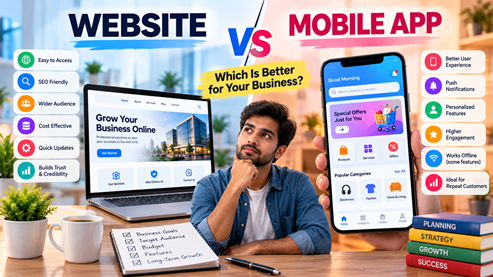
When planning to grow your business online, one important question is: should you build a website or a mobile app? Both options help businesses connect with customers, but they serve different purposes. The right choice depends on your business model, target audience, budget, and long-term goals.
In this guide, we compare websites and mobile apps, explain their advantages, costs, marketing potential, and limitations, and help you decide which solution is best for your business.
What Is a Website?
A website is a collection of web pages that people can access through a browser on a mobile phone, tablet, laptop, or desktop. Customers generally do not need to install anything to visit a website.
Businesses use websites to present their services, showcase products, publish blogs, collect enquiries, accept orders, and share important information. A well-designed website can also help potential customers discover a business through search engines.
Depending on your requirements, you might need static website design, dynamic website development, or e-commerce website development.
What Is a Mobile App?
A mobile app is software designed to run on mobile devices. Depending on the technology, it may be downloaded from an app store or delivered through a web-based app experience.
Mobile apps can provide features such as push notifications, user accounts, saved preferences, loyalty programmes, location-based services, and device-specific functionality. The exact capabilities depend on the app's design, operating system permissions, and technical implementation.
Apps are often useful when customers need to return frequently, manage ongoing activities, or use personalised features that justify installing and maintaining an application.
Website vs Mobile App: Key Differences
| Factor | Website | Mobile App |
|---|---|---|
| Access | Usually accessed through a browser | Usually installed or added to a device |
| Installation | Not normally required | Often required for native apps |
| Google Search visibility | Can attract organic search traffic | App-store discovery and app indexing depend on the implementation |
| Customer engagement | Works well for browsing and information | Can support frequent, personalised engagement |
| Updates | Website changes can be published centrally | Updates depend on the app type and distribution method |
| Development | Cost depends on features, design, and complexity | Cost depends on platforms, features, integrations, and maintenance |
| Best suited for | Discovery, information, leads, and online sales | Frequent usage, loyalty, and specialised mobile experiences |
Benefits of Having a Website for Your Business
1. Reach Customers Through Google
A search-friendly website can help customers find your business when they search for relevant products, services, and solutions. Helpful content, clear page structure, and technical optimisation support discoverability.
Learn more about SEO services in Patna and on-page SEO services. You can also read Google's SEO Starter Guide.
2. Make Your Business Accessible
Customers can usually open a website directly from a search result, social media post, email, or shared link. They do not need to download an app before viewing your services or contacting your business.
3. Generate Leads and Sales
A website can include contact forms, enquiry buttons, WhatsApp links, booking forms, product catalogues, and payment integrations. These features help businesses turn visitors into leads or customers.
4. Build Credibility
A professional website gives customers a place to learn about your business, review your services, understand your process, and find contact information. Regularly updated content and clear business details can strengthen the customer experience.
5. Support Digital Marketing
Your website can act as a central destination for SEO, social media campaigns, content marketing, and online advertising. For a broader marketing strategy, explore social media marketing services in Patna.
Benefits of Having a Mobile App for Your Business
1. Better Experience for Frequent Users
An app can make repeated tasks more convenient by providing saved preferences, account access, order history, and personalised screens. These features are especially useful when customers interact with your business regularly.
2. Push Notifications
Depending on the platform and user permissions, apps can send notifications about order updates, reminders, relevant offers, and account activity. Notifications should be useful and appropriately timed rather than excessive.
3. Loyalty and Personalisation
Businesses can use app features to support loyalty programmes, saved favourites, personalised recommendations, subscriptions, and repeat purchases. These features require a clear reason for customers to keep using the app.
4. Device-Specific Features
Depending on the app and permissions, a mobile application may use device features such as the camera, location services, biometrics, or notifications. These capabilities can be useful for specialised business workflows.
Website vs Mobile App: Which Is More Cost-Effective?
The cost of a website or app depends on the functionality you need rather than the platform alone. A basic website is often a practical starting point for a new business, while a complex e-commerce website can require substantial development and ongoing support.
Mobile app costs vary based on whether you need Android, iOS, or both; account management; payment integrations; notifications; admin tools; security; and ongoing updates. App-store requirements and platform maintenance should also be considered.
Before deciding, list your must-have features and compare the full cost of development, maintenance, marketing, hosting, and future improvements. Avoid choosing a platform only because it appears cheaper at the beginning.
Which Is Better for SEO: Website or Mobile App?
If your goal is to attract customers through Google Search, a website is generally the more direct starting point. Search engines can crawl and index eligible web pages, allowing them to appear for relevant queries.
A mobile app can support customer retention and app-store discovery, but it does not replace the role of a search-friendly website for many businesses. A website can also explain app features and link customers to the relevant app-store listing.
Businesses targeting nearby customers should also consider local SEO services in Patna to improve their local search presence.
Website or Mobile App: What Should Different Businesses Choose?
Small Businesses and Local Services
Salons, consultants, agencies, restaurants, repair services, and local professionals can often start with a responsive website that presents services, location details, reviews, and enquiry options.
Startups
Startups should validate their business idea and customer needs before investing in multiple platforms. A website or web-based MVP may be enough to test demand and collect early feedback.
E-Commerce Businesses
An e-commerce website can support product discovery, search visibility, product pages, checkout, and online orders. A mobile app may become useful later if frequent customers need loyalty features, personalised shopping, or convenient repeat purchases.
Education and Booking Platforms
A website may be suitable for course information, enquiries, registrations, and online booking. An app can be valuable when users need regular reminders, progress tracking, offline access, or frequent account-based interactions.
Businesses With Repeat Customers
If customers use your service frequently and benefit from personalised features, a mobile app may offer additional value. However, the expected benefits should justify the cost of building, promoting, and maintaining it.
Can You Have Both a Website and a Mobile App?
Yes. A website and a mobile app can complement each other. The website can help people discover your business, understand your offerings, and become customers. The app can then support frequent interactions, account-based services, loyalty, and retention.
For many businesses, the practical approach is to launch a strong website first, understand customer behaviour, and build an app when there is a clear business case for it.
What About a Progressive Web App?
A Progressive Web App (PWA) is a web experience built with technologies that can provide some app-like capabilities, depending on browser and operating-system support. Depending on implementation, a PWA may be installable and may support features such as offline experiences or notifications on supported platforms.
A PWA may be worth evaluating if you want a web-first solution with some app-like functionality. Learn more in the web.dev Progressive Web Apps resources.
How to Make the Right Decision
Before investing, ask these questions:
- Do customers mainly need to discover information or use a service frequently?
- Is Google Search visibility a major source of potential customers?
- Do customers need notifications, offline functionality, or device-specific features?
- Can your business support ongoing development and maintenance?
- Would customers have a strong reason to install and regularly use an app?
- Can you start with a website and add app functionality later?
Related Website Development and Marketing Resources
- Website Development Company in Patna
- Static Website Design in Patna
- Dynamic Website Development in Patna
- Ecommerce Website Development in Patna
- Static vs Dynamic Website: Which Is Better for a Business in Patna?
- SEO Services in Patna
- Explore All Owntus Media Services
Frequently Asked Questions
1. Is a website better than a mobile app for a new business?
For many new businesses, a responsive website is a practical first step because customers can access it without installing an app. The best choice depends on the business model, audience, and required features.
2. Can a website replace a mobile app?
A website can handle many business needs, including information, enquiries, bookings, and online sales. However, apps may be better for certain device-specific features, frequent use, or personalised experiences.
3. Which is better for Google rankings: a website or an app?
A website is generally the direct option for attracting organic traffic from Google Search because eligible web pages can be crawled and indexed. An app can complement a website through app-store discovery and customer engagement.
4. Is a mobile app more expensive than a website?
It can be, especially when separate Android and iOS versions, complex features, integrations, testing, and ongoing maintenance are required. Actual costs depend on the scope and technology used.
5. Can a small business start with a website and build an app later?
Yes. Starting with a website allows a business to establish its online presence and learn about customer needs. An app can be developed later if repeat usage or specialised features justify the investment.
6. What is a Progressive Web App?
A Progressive Web App is a web experience that can offer selected app-like capabilities. Its features and installation options depend on the browser, operating system, and implementation.
7. Who can help build a business website in Patna?
Businesses can explore website development services in Patna to understand options for responsive websites, business websites, dynamic platforms, and e-commerce stores.